Marillion sought sanctuary from infamy and insanity and found direction in the dancing shadows of barbed wire kisses and roundabout rainbow remembrances of this backstage bitter suite. Although their second album 'Fugazi' had been a top five success in the UK, their record label was unhappy with the expense that went into it. After rehearsals, the band was shipped off to Hansa Tonstudio in Berlin where the rates were much cheaper. The sessions for 'Misplaced Childhood' featured Fish (Derek Dick) on vocals and cover concept; Steve Rothery on guitars and photography; Mark Kelly on keyboards; Pete Trewavas on bass; and Ian Mosley on percussion; with Chris Kimsey on production and mixing; Thomas Stiehler on recording; Mark Freegard on mixing engineering; Mark Wilkinson on sleeve design and illustration; Julie Hazelwood on collage; and Bill Smith Studio on artwork design. Rothery: "In the early part of 1985 we moved into a big old house called Barwell Court in Chessington for the writing sessions of the new album. I felt very inspired at around that time and the constant flow of ideas between us all meant that we worked at quite an incredible pace (for us at least), writing nearly all of side one within the first week. A few weeks later we met with Chris Kimsey, the producer, who proceeded to tell us about this great studio in Berlin called Hansa, and how we should definitely record the album there. Arriving in Berlin in February 1985 I remember being struck by the incredible vibrance and energy the city had. Every day I would follow the graffiti clad wall from the Hervis Hotel around the corner to the studio. My bedroom window at the hotel looked out across the wall into no-man's land and the sentry towers and patrol guards made you feel like you were a character in some Graham Greene novel."
Trewavas: "Thinking back, the boys in the band seemed to be very relaxed with each other over the writing period of Misplaced Childhood . There was none of the mayhem compared to Fugazi Fugazi Real to Reel Fugazi Real to Reel
Fish: "Being away from family, loved ones and the sanctuary of home trapped in a cocoon surrounded by media and sycophants in a traveling circus where the quest for normality and sanity is a constant daily struggle...I'd been paying the price. My big on/off relationship had finally bit the dust, left behind in a haze of exhaust fumes as I careered off in search of my elusive grail. I was off balance and quickly lost in a depraved wilderness in which I soon made a home. The touring lifestyle fed my addictions on every level and when the bus dropped me off at my newly acquired house in Albert Street, Aylesbury I found myself very alone and dislocated from all the distractions that had fed my desire to escape commitments, responsibilities and realities...An envelope arrived one of these days. Inside there was a short letter from an old girlfriend with the recommendation to digest the accompanying contents - a tab of very strong acid...I immersed myself in a warm bath for a while, returning to the womb and trying to reassemble myself. I spent the rest of the night crouched on the floor listening to music, watching walls breathe and staring at a large repro print called 'Padres Bay' 'Padres Bay' Misplaced Childhood ...We were to discuss it later as a band and felt the idea was worth pursuing at our forthcoming writing sessions in Barwell Court, a Victorian mansion near Chessington which was hired out as a residential rehearsal studio, the main writing room ironically a former children's' nursery. The rest of the band threw their ideas in the hat and as musical sections were given names and gathered on the blackboard the first side of the album started to appear. There was no tension and the process felt very natural and organic as the curve began to grow and the sections gelled into a seamless piece of music. Not everyone was happy. Outside our creative circle there was a nervous but respectful air that questioned our decision to pursue such an obviously uncommercial venture. After all this was the mid 80's when everyone was driving sleek polished pop songs and an album steeped in the tradition of 70's progressive rock, two slabs of music with the working titles of Side 1 and Side 2 (in '85 vinyl was still king!), was not exactly a move that could be decreed as a fashion statement. More ominous worries were voiced by the record company who although relatively happy with our development on the international stage, believed that radio play was going to be hard to get and support in the USA in particular would be difficult to gather for an album with no obvious singles. We however had a different opinion and enough weight to move on our convictions. We also knew that there were two sections that more than hinted at singles. One was 'Kayleigh', the other 'Lavender'...We all knew it was a major album. I don't have enough space to describe concepts, details, recording techniques, lyrical inspirations etc.etc. But read the book when it comes out! It was the turning point of all our lives and the intensity of the experience still rings a smile, never to be repeated. Never again Misplaced. Do you remember?" 'Misplaced Childhood' found its way to number forty-seven in the US, fifteen in Sweden, ten in Norway, six in the Netherlands and Switzerland, three in Germany, and number one in the UK.
http://www.marillion.com/ "Kayleigh" reached number seventy-four in the US, nineteen in Switzerland, fourteen on the US hot mainstream rock tracks chart, twelve in the Netherlands, eight in Norway, seven in Germany, and number two in the UK.
VIDEO
"Lavender" went to thirty-nine in Germany and five in the UK.
VIDEO
"Heart of Lothian" charted at fifty-one in Germany and twenty-nine in the UK.
VIDEO 'Misplaced Childhood' full album:
https://myspace.com/marillion/music/album/misplaced-childhood-10545128 VIDEO All lyrics written by Fish, all music composed by Mark Kelly, Ian Mosley, Steve Rothery, and Pete Trewavas.
Side one
1. "Pseudo Silk Kimono" 2:15 2. "Kayleigh" 4:04 3. "Lavender" 2:28 4. "Bitter Suite" 5:54 a. "Brief Encounter" b. "Lost Weekend" c. "Blue Angel" d. "Misplaced Rendezvous" e. "Windswept Thumb" 5. "Heart of Lothian" 6:07 a. "Wide Boy" b. "Curtain Call" Side two
6. "Waterhole (Expresso Bongo)" 2:13 7. "Lords of the Backstage" 1:53 8. "Blind Curve" 9:30 a. "Vocal Under a Bloodlight" b. "Passing Strangers" c. "Mylo" d. "Perimeter Walk" e. "Threshold" 9. "Childhoods End?" 4:33 10. "White Feather" 2:24 reissue bonus tracks
"Lady Nina" 5:50 "Freaks" 4:08 "Lavender Blue" 4:23 "Pseudo Silk Kimono / Kayleigh / Lavender" live
VIDEO "Waterhole / Lords of the Backstage / Blind Curve" live
Marillion- Waterhole/Lords of the Backstage... by 69stepe
Marillion fought their way through myriad trials and tribulations to breach the dawn of the sentimental mercenary with this stumbling visionary suburbanshee. While their similarity to early Genesis had drawn both praise and criticism, the group had found an audience for their neo progressive sound through extensive touring for their debut album 'Script for a Jester's Tear' but founding drummer Mick Pointer (who had originally come up with the name Silmarillion from the book by J.R.R. Tolkien) was fired when it was over. What followed was a succession of different drummers including Andy Ward, John Martyr, Jonathan Mover, and finally Ian Mosely.
Mark Kelly reveals: "We decided to lock ourselves away in a house in Wales to write 'Fugazi' Simon Hanhart was responsible for holding the sessions together as Nick became more and more unreliable. Throughout the mixing we had to keep changing studios because the time we had allotted kept running out. We clocked up 10 different studios on that album...In an effort to finish the mixing before the tour started another producer was hired, Tony Platt...We had our reservations about Tony but felt we had no choice. We then had a ridiculous situation of trying to be in two studios at once, Fish Ian and Pete were in Masion Rouge or was it Odyssey? and Steve and myself were in Abbey Road with Tony mixing Incubus."
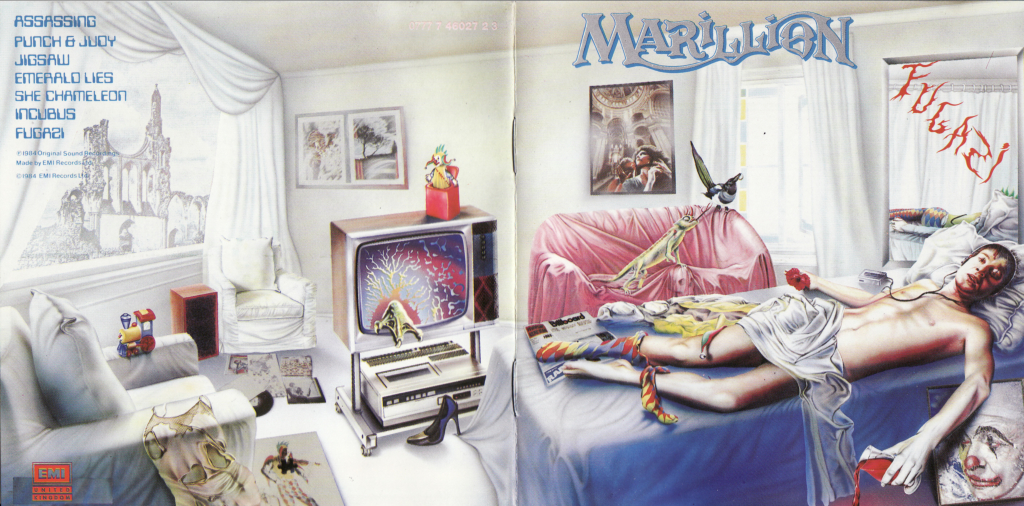
'Fugazi' features Fish (Derick Dick) as the Voice; Steve Rothery on Yamaha SG2000, Gibson Les Paul Standard, Roland GR303/505 Guitar Synth, Fender Stratocaster, Ovation Acoustic, Roland JC120 Combo, Marshall 50W MV Combo, Mesa Boogie, Roland 501 Chorus/Echo, and Boss Effects Pedals; Mark Kelly on Bosendorfer Grand Piano, PPG Wave 2.2, Roland Jupiter 8, Minimoog, Emulator, Yamaha DX7, Yamaha GS1, Korg CX3, Church Organ (Recorded at Angel Studios in London); Pete Trewavas on Aria and Fender basses, and Trace Elliott and Peavey Amplification; and Ian Mosley on Yamaha Drums, Zildjian Cymbals, and Simmons Drums; with Linda Pyke doing the backing vocal on "Incubus"; and Chris Karen providing additional percussion. Dick remembers: "Our second album was to be aptly named ‘Fugazi' ‘Script' Auditions and rehearsals at Nomis Studios first provided Andy Ward (ex Camel) who lasted until midway through our first American tour before succumbing to a near nervous breakdown and leaving us to cancel the remaining dates. John Martyr had a short appointment with us in the USA but failed to gain the support of the band as a whole. So it was back to Nomis and on a recommendation we auditioned Jonathan Mover prior to relocating to writing for the ‘difficult' second album at Rockfield Studios in South Wales. I didn't like him or his technical abilities which in my opinion were out of line with our quintessential British style. We were under a lot of pressure to make a decision and get into the writing sessions, so I backed off and hoped it would work out. It didn't. I became more and more irritated by Jonathan and reluctantly forced a ‘me or him' scenario on the others I admit I wasn't exactly opened armed to Jonathan and did indulge in psychological warfare (including cherry bombing his bedroom and bathroom at every available opportunity!), in order to test his mettle. I just knew he wasn't right for us and I also knew who was. Ian Mosley had been drumming with Steve Hackett the ex Genesis guitarist. I'd seen him twice, most recently during a visit back home to Edinburgh after the ‘Script' ‘Script' 'Fugazi' 'Fugazi' 'Fugazi' http://www.marillion.com/ https://myspace.com/marillion/music/album/fugazi-9647864 "Assassing" – 7:02 (Dick/Kelly/Rothery/Trewavas)
"‘Assassing' (why I put the ‘g' on the end remains a mystery to me!), was inspired by the culls that persisted throughout the early stages of the band, but focused in particular on Mick Pointer more than anyone. "
VIDEO
VIDEO
"Punch and Judy" – 3:21 (Dick/Kelly/Rothery/Trewavas/Mover)
"When I'd penned the words I'd always heard a Bo Diddley type beat, but by the time Jonathan had his kit out and on it, it bastardised itself into a quirky over complicated rhythmic base that took it miles off a mainstream single. The lyric was about my paranoia over commitment in a relationship and about my vision of a marital hell culminating in a scenario of blaming the partner for all of life's failures Traditionally dark by my standards it never really worked as the ideal single. "
http://www.youtube.com/watch?v=5W9nXlbc9ag http://www.youtube.com/watch?v=8kK90TUyLzk "Jigsaw" – 6:49 (Dick/Kelly/Rothery/Trewavas)
"‘Jigsaw' is probably the ‘wordiest' lyric I've ever written. All about the games we play in a relationship and the secrets we hold back until they're ready to be played. The chorus is still a favourite but the verses were just too complicated. "
http://www.youtube.com/watch?v=MnpaSWQ2F2w "Emerald Lies" – 5:08 (Dick/Kelly/Rothery/Trewavas/Mosley)
"‘Emerald Lies' was about jealousy and in my never ending break up, get together, break up cycle with my long suffering girlfriend, the lyric was obvious. Touring was having a very negative effect on my personal life (from her point of view). "
http://www.youtube.com/watch?v=j-XPNZxA7Mk http://www.youtube.com/watch?v=-DOgOtw6clE "She Chameleon" – 6:52 (Dick/Kelly/Rothery/Trewavas)
"‘She Chameleon', a song that existed in some semblance of order in 1983 was resurrected for inclusion. Inspired by the ‘groupie' phenomenon that came to be in 1983 and tripping on acid backstage with Julian Cope after a ‘Teardrop Explodes' concert - it was about my attitudes to sex on the road. The question was ‘who was using who?'. The middle section was always too ‘twee' for my liking and I'd always wanted a more gothic approach. It never happened. "
http://www.youtube.com/watch?v=i3ipK8vuPCY http://www.youtube.com/watch?v=23X3XeMxohY "Incubus" – 8:30 (Dick/Kelly/Rothery/Trewavas)
http://www.youtube.com/watch?v=Sis6GVEtHa0 http://www.youtube.com/watch?v=S01SuU4aiKk
"Fugazi" – 8:12 (Dick/Kelly/Rothery/Trewavas/Mosley)
"The title track was inspired by a journey on the Piccadilly line from Earls Court where I lived in a flat for a while with my girlfriend, to the Marquee Club where I lived during the night. Coming down from a trip and listening to my Walkman and viewing the other occupants if the carriage it summed up the album and my views on life at the time - Fugazi we were. "http://www.youtube.com/watch?v=CPm8SWILMco http://www.youtube.com/watch?v=yCgK5qFSDJg