Herbie Hancock explored the frontiers of jazz with the sketches of hard bop and funk fusion that create the secret enchantment of this mythic modal concept album. While playing with Miles Davis during the better part of the sixties, Hancock recorded several albums on the side for Blue Note Records, starting with his solo debut 'Takin' Off' and continuing with 'My Point of View' and 'Inventions and Dimensions'. For 'Empyrean Isles'he once again recorded with producer and Blue Note founder Alfred Lion at Rudy Van Gelder's studio in Englewood Cliffs, New Jersey. The sessions featured Herbie Hancock on piano; Freddie Hubbard on cornet; Ron Carter on bass; and Tony Williams on drums. Hancock and the rhythm section create an improvisational groove that allows Hubbard to soar on his solos.
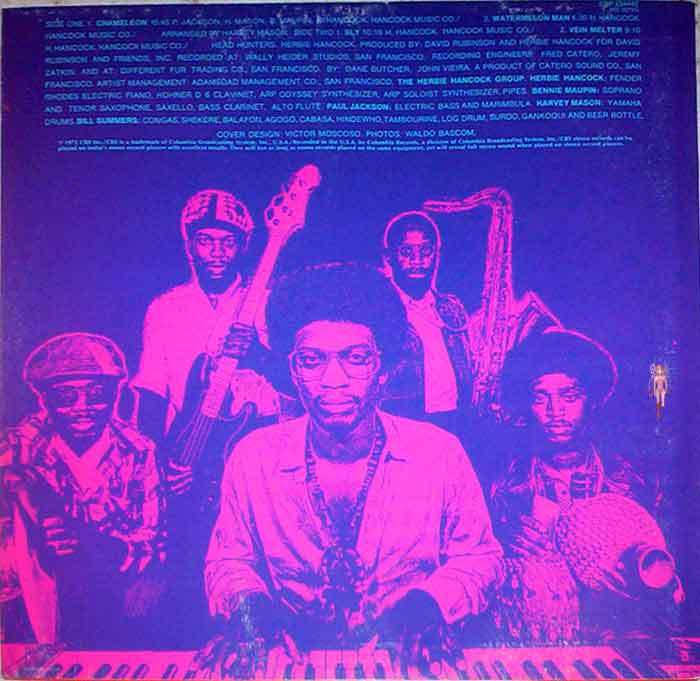
Herbie Hancock brought together a new band and paved the way for hip hop with the this funky fusion of jazz with R&B, electronic, and African music. After the electronic experiments of 'Mwandishi', 'Crossings', and 'Sextant';Hancock was looking for a new direction. In the reissue liner notes, Hancock reveals: "I began to feel that I had been spending so much time exploring the upper atmosphere of music and the more ethereal kind of far-out spacey stuff. Now there was this need to take some more of the earth and to feel a little more tethered; a connection to the earth....I was beginning to feel that we (the sextet) were playing this heavy kind of music, and I was tired of everything being heavy. I wanted to play something lighter." For the new sessions, Hancock stuck with his long-time collaborator Bennie Maupin and assembled a new group called the Head Hunters. Their first album 'Head Hunters' was produced by Herbie Hancock and David Rubinson and recorded at Wally Heider Studios and Different Fur Trading Co. in San Francisco, California with Herbie Hancock on Fender Rhodes electric piano, Hohner D6 clavinet, ARP Odyssey synthesizer, and ARP Soloist synthesizer; Bennie Maupin on Soprano and tenor saxophones, Saxello, Bass Clarinet, and Alto flute; Paul Jackson on Electric bass and Marímbula; Bill Summers on Congas, Shekere, Balafon, Agogô, Cabasa, Hindewhu, Tambourine, Log drum, Surdo, Gankogui, and Beer Bottle; and Harvey Mason on drums.
Herbie Hancock started his career on a high note with the sophisticated jazz of this soulful soaring prolegomenon. Hancock was a child prodigy who performed Mozart at the age of eleven. During his teens he became enamored with jazz and secured a recording contract with Blue Note Records. 'Takin' Off' was recorded in one session on May 28, 1962 and produced by one of the founders of the label Alfred Lion at the studio of engineer Rudy Van Gelder in Englewood Cliffs, New Jersey. The session featured Hancock on piano with accompaniment by Blue Note heavies Dexter Gordon on tenor saxophone, Freddie Hubbard on trumpet, bassist Butch Warren and Billy Higgins on drums. 'Takin' Off' didn't chart; but it was so well received that Miles Davis asked Hancock to join his Second Great Quintet.
Hancock says: "In reflecting on my childhood, I recalled the cry of the watermelon man making his rounds through the back streets and alleys of Chicago's south side. The wheels of his wagon beat out the rhythm on the cobblestones."
'Takin' Off' full album:
All compositions by Herbie Hancock. "Watermelon Man" – 7:09 "Three Bags Full" – 5:27 "Empty Pockets" – 6:09 "The Maze" – 6:45 "Driftin'" – 6:58 "Alone and I" – 6:25