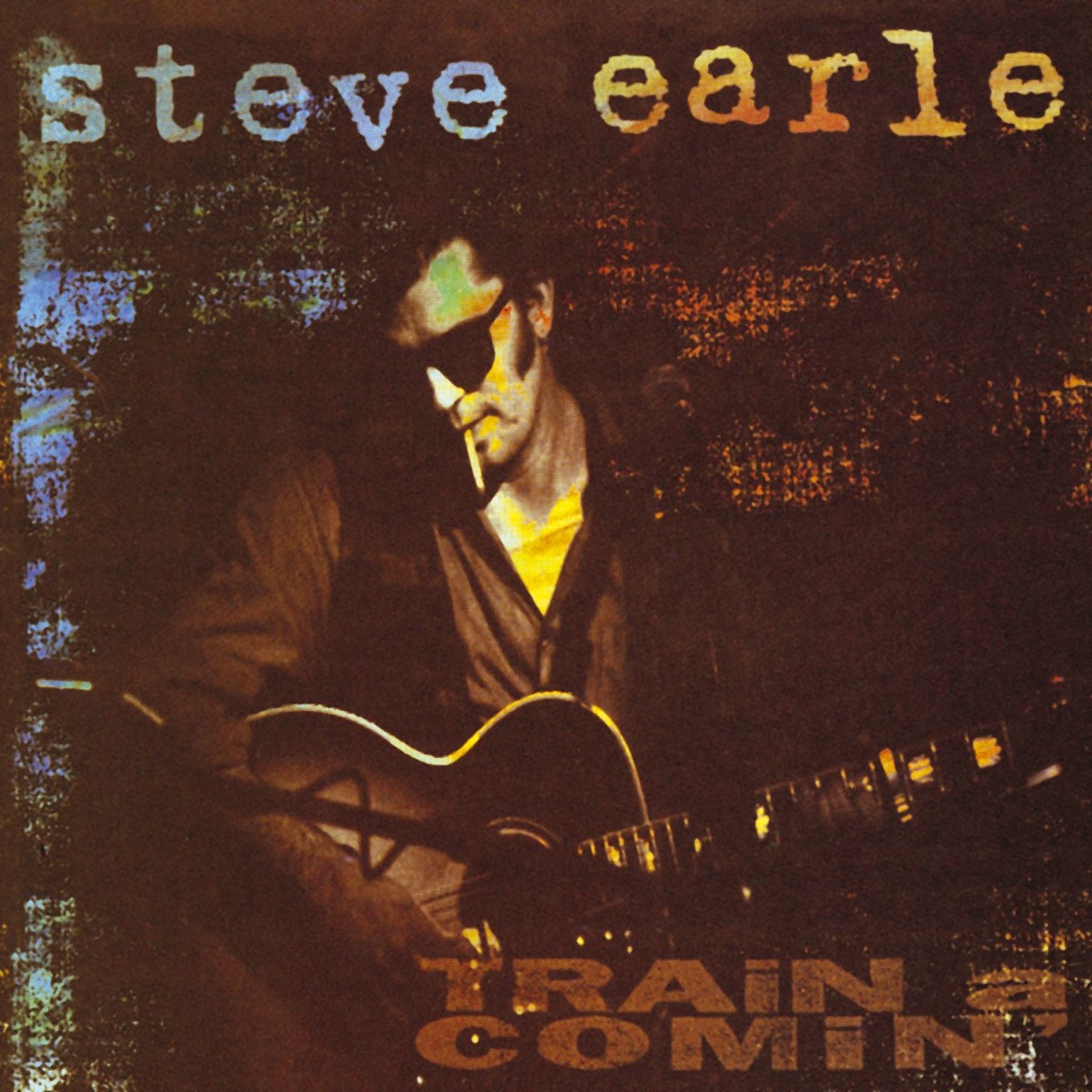
Steve Earle came back from oblivion with the mercenary mystery of this stripped down hometown blues. He had found early success with the rock country sound of his debut Guitar Town Exit 0 Copperhead Road The Hard Way
Earle would reveal: "At forty it becomes clear - especially if you get to be forty the way I did, defying gravity - that what's important is your life and your wife and your kids. There is an edge in things you do when you're younger, and you think it's life or death. But if you survive long enough, artistically and otherwise, it suddenly dawns on you one day that you didn't have to go through maybe all the shit that you went through, but there ain't nobody in the world that could have told you that when it was goin' on. It's just that simple."
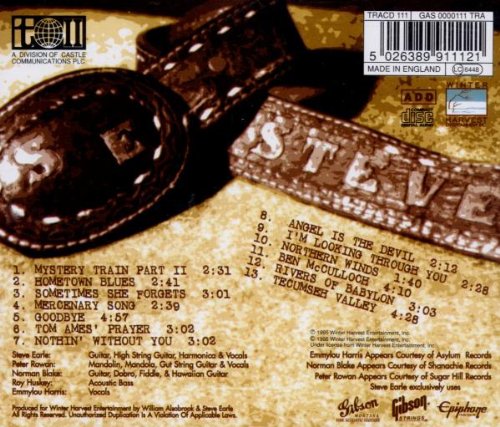
After his release, he signed with Winter Harvest Records and recorded 'Train A Comin'' in Nashville over the course of five days. The sessions featured Steve Earle on guitar, high string guitar, 12 string guitar, harmonica, mandolin, and vocals; Peter Rowan on mandolin, mandola, gut string guitars, and vocals; Norman Blake on Hawaiian guitar, dobro, mandolin, fiddle, and guitar; Roy Huskey, Jr. on acoustic bass (and inspiration on "I'm Looking Through You"); and Emmylou Harris on vocals for "Nothin' Without You" and "The Rivers of Babylon". Earle would exclaim: "I was goin' for a sound where it sounded like old Opry stuff, where everybody stepped around the mike, which is real close to what we actually did. It ended up being even more of an organic record than I thought it was gonna be ... This ain't my unplugged record! ... This is what I used to do, and it is what the great players on this record do every day of their lives, come hell or high water; but make no mistake, this ain't no part of no unplugged nothin' ... [ 'Train A Comin'' is ] exactly the record I needed right now. No major label would let me make this record coming back after four years especially. I always wanted to do it. It was a low-pressure record." 'Train A Comin'' did not chart; but it was nominated for a Grammy for Best Contemporary Folk Album.
http://steveearle.com/ "Goodbye"
https://www.youtube.com/watch?v=7nb2JmcBuEo VIDEO I remember holdin' on to you,
"Mercenary Song"
https://www.youtube.com/watch?v=WHE1dM4hYCw VIDEO "Hometown Blues"
https://www.youtube.com/watch?v=yvAbusE1veU VIDEO "Angel is the Devil" with The Supersuckers
https://www.youtube.com/watch?v=JEuYs7Dls0Y VIDEO 'Train A Comin'' full album:
VIDEO
https://myspace.com/steveearlemusic/music/album/train-a-comin-9813237 All songs written by Steve Earle unless otherwise noted. Listing reflects Earle's sequencing of the record.
"Mystery Train, Pt. 2" - 2:31 "Hometown Blues" - 2:41 "Sometimes She Forgets" - 3:01 "Mercenary Song" - 2:39 "Goodbye" - 4:57 "Tom Ames' Prayer" - 3:02 "Nothin' Without You" - 3:02 "Angel Is the Devil" - 2:12 "I'm Looking Through You" - 2:28 (John Lennon and Paul McCartney) "Northern Winds" - 1:40 (Norman Blake) "Ben McCulloch" - 4:10 "Rivers of Babylon" - 3:30 (Brent Dowe, Trevor McNaughton, Frank Farian, George Reyam) "Tecumseh Valley" - 4:28 (Townes Van Zandt)
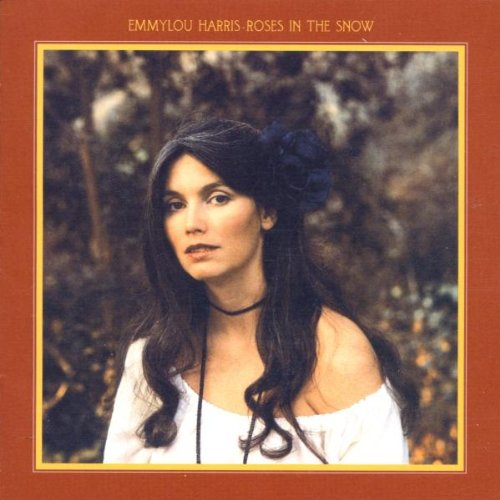
'Blue Kentucky Girl' 'Light of the Stable' 'Roses in the Snow' “If you’re looking at an overview — I definitely came in through the country door. It’s like saying, ‘Where were you born. What are your roots?’ I was a folk singer who became totally over the edge with country music. I found my voice and style working with Gram Parsons. I learned how to listen to George Jones records and the Louvin Brothers. Listening to harmonies. Being enthused. I was a woman with a mission after Gram’s death, trying to keep his music alive — and bring what I liked about country music to people like me who came to it without growing up with it. Discovering the beauty and depth of it instead of the caricature. This politically incorrect music (laughs) I really was on a crusade. Even from my very first record, I think I established a pattern of eclecticism. And I was hoping to encourage other people to go out and buy George Jones records. And discover the music that shouldn’t be left behind. There was a power and beauty to it...Overseas there is no confusion. If I’m a country artist, whatever record I do is country. They don’t pigeonhole it. Here the pigeonholing is rampant. I never followed a pattern. If I had any kind of style it was no style. I could do a traditional record like ‘Blue Kentucky Girl' ‘Roses in the Snow' ."'Roses in the Snow' I think [what I want is] all determined by the song really. All the musicians I have worked with are just very creative and it’s a thing that happens in the studio at that moment of recording. And also it’s not like this is a country record. Over the years, we have done a few things that were very specific. I think the best example of that was Roses in the Snow ."
"Wayfaring Stranger"
VIDEO "The Boxer"
VIDEO "Jordan"
https://www.youtube.com/watch?v=FoTEme72qx8 VIDEO "Gold Watch and Chain"
https://www.youtube.com/watch?v=-vGJgzEP41U VIDEO 'Roses in the Snow' full album:
https://myspace.com/emmylouharris/music/album/roses-in-the-snow-17587712 VIDEO
"Roses in the Snow" (Ruth Franks) – 2:32 "Wayfaring Stranger" (Traditional/arr. Brian Ahern) – 3:26 "Green Pastures" (Traditional/arr. Brian Ahern) – 3:08 "The Boxer" (Paul Simon) – 3:16 "Darkest Hour is Just Before Dawn" (Ralph Stanley) – 3:22 "I'll Go Stepping Too" (Tom James/Jerry Organ) – 2:16 "You're Learning" (Ira Louvin/Charlie Louvin) – 2:57 "Jordan" (Traditional/arr. Brian Ahern) – 2:07 "Miss the Mississippi and You" (Bill Halley) – 3:40 "Gold Watch and Chain" (A.P. Carter) – 3:12 bonus tracks:
"You're Gonna Change" (Hank Williams) – 2:40 "Root Like a Rose" (Nancy Ahern) – 4:45
Emmylou Harris found a saving grace by straightening out her crooked way of thinkin' and hit her stride by telling everything with honky tonk humor, too far gone heartbreak, and a hot band. She had given up her drama scholarship to the University of North Carolina at Greensboro to pursue music in the folk scene of New York City's Greenwich Village, where she met and married another songwriter Tom Slocum. Her debut album 'Gliding Bird' was produced by Ray Ellis for Jubilee Records, which went bankrupt soon after its release in 1969. She and Slocum divorced and she left with their newborn daughter Hallie to the suburbs of Washington D.C. for what Harris considers: "a tough time. I was living on food stamps and working six nights a week in clubs, trying to support my daughter. I had pretty much given up on the idea of 'making it' by that point." She was recommended by Chris Hillman, who had seen one of her performances in 1971, to his former bandmate Gram Parsons; and she toured as part of his Fallen Angels Band, as well as collaborating on his albums 'GP' and 'Grievous Angel' "[Gram] never treated me like the chick singer; he was very gracious, a real Southern gentleman...I didn't get his music; I didn't quite get his singing either. I had always sung folk music and I saw country music as kind of hokey. So at first I just saw what we were doing as an opportunity to make some money singing on a record. But as we began singing these harmonies it seemed like we sounded good together and I began to appreciate what he was doing...We had elements of being a couple through a musical relationship that became very intense. I think I kept a little bit of a distance, though. I mean, Gram was married and, though I wasn't that much of a prude, I probably didn't want to mess with that. Toward the end, I couldn't really deny it any more. I knew what I felt for him, and I just assumed that that was something that was going to happen, never thinking that we would never have the chance. When I got the call that he had died, I was just so shocked...I felt I couldn't possibly stop. Because that was the only way I could deal with it. I had no idea where I was going to get to, or end up, but all these extraordinary things came together in just the right way to put me in a place where I could actually realise whatever it was I was trying to do. Mainly, I wanted to carry on with Gram's music. That was what pushed me forward...I had just assumed I would go forward making music with Gram until whenever. Then, when it was cut so short, I had to move forward on my own. It was hard, and a very bleak time for me. My daughter was with my parents and I hardly saw her. I didn't have experience making records, my education was incomplete and I'd lost my teacher, my mentor. In the end, I was very fortunate in the community of people I found – and who found me – who helped put me on the right path. And also that they understood I was grieving and was in a very vulnerable place."
'Pieces of the Sky' features Emmylou Harris on vocals, and acoustic guitar; with producer and engineer Brian Ahern on acoustic guitar, high-strung guitar, super 400 acoustic guitar, and bass; James Burton on electric guitar, gut-string guitar, and dobro; Glen D. Hardin on piano, electric piano, and string arrangements; Nick DeCaro on string arrangements; Bernie Leadon on acoustic guitar, bass, banjo, dobro, and backing vocals; Herb Pedersen on acoustic guitar, 12-string guitar, banjo, and backing vocals; Bill Payne on piano; Bruce Archer on acoustic guitar; Rick Cunha on acoustic guitar and high-strung guitar; Amos Garrett on electric guitar; Ben Keith and Danny Pendleton on pedal steel; Richard Greene on fiddle; Byron Berline on fiddle and mandolin; Ricky Skaggs on fiddle and viola; Duke Bardwell, Tom Guidera, and Ray Pohlman on bass; Mark Cuff and Ron Tutt on drums; and Linda Ronstadt and Fayssoux Starling on backing vocals. The sessions were also engineered by Chris Skene, Paul Skene, Fran Tate, and Stuart Taylor.
Harris reveals: "I had been signed to Warner/Reprise. They brought a great team together of a very, very successful producer, Brian Ahern, who had all those great Anne Murray records. And I was, you know, a fledgling artist. Basically I was signed because I had gotten a bit of notoriety singing on two Gram Parsons records, Gram who had died in 1973, and I was signed in '74. And so, you know, everyone's concerned, you know, we've got to get the material, got to get it right. So I went up to Toronto where Brian lived and to listen to material and pick material. And I didn't really know what I wanted to do, but I found out right away that I knew what I didn't like. And Brian played me a whole day's worth. We went a whole day through a pile of cassettes, few people remember cassettes, of material that just did not do anything for me. And he kind of smiled, and he said, well, he said, I've got one more thing, and I haven't listened to this yet. It's been sent to me, a writer that I've signed who I've not heard but on the recommendation of someone whose opinion I respect. So for the first time Brian Ahern and I listened to the voice and the songs of Rodney Crowell. And the first song that was on the tape was "Bluebird Wine." And I just knew that we had struck gold, that there was just something in his voice, in the music and the energy that was there."
'Pieces of the Sky' went gold, charting at number seventy-six in Canada, forty-five in the US, and seven on the US country album chart.
http://www.emmylouharris.com/ "Bluebird Wine"
VIDEO "If I Could Only Win Your Love" was a breakthrough hit, going to number fifty-eight on the US pop chart, four on the US country chart, and number one on the Canadian country chart.
https://www.youtube.com/watch?v=6g8EqgRk-nw VIDEO https://www.youtube.com/watch?v=CjRi1vFlrGQ VIDEO "Boulder to Birmingham" was written in memory of Gram Parsons.
https://www.youtube.com/watch?v=xgzlNxUF3b0 VIDEO I don't want to hear a love song
'Pieces of the Sky' full album:
https://myspace.com/emmylouharris/music/album/pieces-of-the-sky-8102747 VIDEO
"Bluebird Wine" (Rodney Crowell) – 3:18 "Too Far Gone" (Billy Sherrill) – 4:05 "If I Could Only Win Your Love" (Charlie Louvin, Ira Louvin) – 2:36 "Boulder to Birmingham" (Emmylou Harris, Bill Danoff) – 3:33 "Before Believing" (Danny Flowers) – 4:44 "The Bottle Let Me Down" (Merle Haggard) – 3:16 "Sleepless Nights" (Felice and Boudleaux Bryant) – 3:25 "Coat of Many Colors" (Dolly Parton) – 3:42 "For No One" (John Lennon–Paul McCartney) – 3:40 "Queen of the Silver Dollar" (Shel Silverstein) – 5:14 bonus
"Hank and Lefty" (Dallas Frazier, Doodle Owens) – 2:50 "California Cottonfields" (Dallas Frazier, Earl Montgomery) – 2:47
Old and in the Way came together to jam some old timey tunes and came away with a bluegrass blockbuster. David Griman reveals how the supergroup of sorts was born: "I was playing bluegrass in the '60s. In the late '60s I got into a rock band with Peter Rowan called Earth Opera. I don’t know what you’d call that -- folk-rock? I don’t like labels. I’ve always had a sound of everything I’ve done, and I think that’s the way most musicians look at it - I just hate to be typecast. But I got interested in listening to jazz in the late '60s, or the mid-to-late '60s ... This is a tough business, but Jerry made it all seem easy. He said, ‘I can get us gigs,’ because he was having fun...We didn’t go up there [to Jerry's place Stinson Beach] with the idea of trying to form a band. He had never met Peter, and Peter was a Blue Grass Boy.” Soon, Jerry’s friend John Kahn joined on bass. “We played a few gigs like that and then we had a few different fiddle players sitting in. I know John Hartford played at least one of those Boarding House gigs. I don’t know if there’s a tape of that; and Richard Greene played several gigs. Jerry booked us five East Coast tour dates, but Richard Greene couldn’t do this tour. I don’t think any of us had ever met Vassar Clements, but Rowan had his phone number and we called him up, We asked him to join us and he graciously agreed! Vassar really enjoyed it, so when we were playing these small local clubs in San Francisco, we’d just fly him out. Personnel stabilized, and we started getting better and adding tunes. These two gigs, forty years ago in October, were consecutive Monday nights at the Boarding House. The club was down a flight of stairs and it was one of those places that Jerry could just book for two or three nights, or whatever he wanted. By that time, Owlsey Stanley III was recording our shows. The audio wizard and architect behind the Grateful Dead’s “Wall of Sound” was returning to the scene after a few years hiatus. He used a Nagra, a state-of-the-art portable tape recorder made in Switzerland, and he had a bunch of great mics and a mixer and was following Old & In The Way around and putting up his mics and taping our gigs. It was a fun thing. We weren’t taking it seriously. It had a vibe that people liked, and still do.”
Peter Rowan remembers: “David [Grisman] and my brothers were living there at the beach—and he brought me up to Jerry’s house one day...David said let’s go up and see Jerry. That’s what you do when you have bluegrass in your blood, you play all the time to try to further the music. And we went up to Jerry’s house and there was Jerry standing outside in his garden with that banjo strapped on and he was playing. He played the banjo, just laughing, standing in the gardens. David and I drove up and we took our instruments out and just started playing out in the garden...We didn’t exactly know what we were doing but we enjoyed going through the old song books. It was a great outlet for Jerry and someone told me that I didn’t know how important this was for him. Of course we didn’t know how important it was for him because we were all young and stupid. And he was touring with the Dead all the time and I figured that was his gig...That was really a special time. We would just take out the songbooks and sort of really marvel at what was there in terms of what was there in bluegrass. Jerry was rediscovering his whole connection with the music and I think that was kind of connection that went back to his youth. Bluegrass represented a happy time for him, a time of growth, a time of discovery. And so every time that we played together, he was getting off on the sense of discovery that originally the bluegrass had been for him. He discovered something with Old and in the Way that made him really happy. And, to be around him, his happiness was infectious ... We finished a show one evening, and the band came off the stage, and some of the members started quibbling that if we had done it this way or that way, we could have played it better...and Garcia — just like a zen master — said, 'No thoughts.' The dressing room was very quiet. He just didn't want a whole lot of conceptualizing over something that was fleeting. And I think that permeated his worldview."
'Old and in the Way' was recorded October 8, 1973 at the Boarding House in San Francisco. P roduced and mixed by David Grisman with recording engineers Owsley Stanley and Vickie Babcock; the live set featured Vassar Clements on fiddle; Jerry Garcia on banjo and vocals; David Grisman on mandolin and vocals; John Kahn on acoustic bass; and Peter Rowan on guitar and vocals. Greg Irons did the Sleeve illustration.
Garcia would consider: "That was a good band. It was satisfying and fun to be in...We ran into a really weird problem in terms of dynamics which was that bluegrass music is like chamber music: it’s very quiet. And if the audience got at all enthusiastic during the tune and started clapping or something, it would drown out the band and we couldn’t hear each other ... (laughs) Oh I was real hot when I was a kid. Now my reasons for playing banjo and my reasons for liking bluegrass music are completely different from when I started, ‘cause then I was really hot...The truth is, we had much better performances than were on that record...We had performances that were heart-stopping. And perfect, you know, but there weren’t as many that were recorded that well...That was really a thrilling band. And I think that was the nicest that Vassar’s played, too. When he was playing with Old And In The Way, he played the maximum of mind-blowing but beautifully tasty stuff, and the music had enough interesting kinds of new changes and new things happening – Pete’s good songs for example – so that Vassar had a chance to blow with a lot of range. More than he does normally. That was neat."
'Old and in the Way' was for years the biggest selling bluegrass album of all time. Grisman gripes: "[ Old and in the Way ] did [wonders for bluegrass music], but it was long after it was over. You have to realize that the band played for less than a year, about 9 months and the record didn't come out until two years after the band had stopped playing. It came out in 1975. Any effect it had was after the band ceased to exist. There were only ten songs on that record and they were recorded in a small club...The effect was happening when we were sleeping somewhere else, so we never really felt the effect of it other than delayed royalty payments. The effect was somewhere else ... Although we didn’t realize what an impact this music would have at the time, we had a lot of fun playing the bluegrass music we loved and these tapes reveal that in a big way.” http://www.vassarclements.com/ http://jerrygarcia.com/ http://www.davidgrisman.com/ http://www.peter-rowan.com/ 'Old and in the Way' full album:
https://www.youtube.com/watch?v=16EYejUic_0 VIDEO "Pig in a Pen" (Traditional) -- 0:00
"Midnight Moonlight" (Peter Rowan) -- 2:51
"Old and in the Way" (David Grisman) -- 9:03
"Knockin' on Your Door" (Traditional) -- 12:08
"The Hobo Song" (Jack Bonus) -- 15:46
"Panama Red" (Rowan) -- 20:58
"Wild Horses" (Mick Jagger, Keith Richards) -- 23:51
"Kissimmee Kid" (Vassar Clements) -- 28:11
"Land of the Navajo" (Rowan) -- 31:42
Live at Boarding House. San Francisco 4 16 73
https://www.youtube.com/watch?v=LjBt8hg275w VIDEO Goin' To The Races
Tragic Romance
Katie Hill
The Willow Garden
'Til The End Of The World Rolls 'Round
Pig In A Pen
Panama Red
Lonesome L.A. Cowboy
Hard Hearted
Wild Horses
Lost
Blue Mule
Live at The Boarding House, San Francisco, CA 07/23/73
https://www.youtube.com/watch?v=nDiCN33eGUc VIDEO 01 - Cheyenne
02 - Down Where The River Bends
03 - Love Please Come Home
04 - Midnight Moonlight
05 - Fanny Hill
06 - Hard Hearted
07 - Lonesome L.A. Cowboy
08 - Pig In A Pen
09 - Panama Red
10 - Wild Horses
11 - White Dove
12 - Wicked Path Of Sin
13 - Blue Mule
14 - Orange Blossom Special
15 - Old & In The Way Breakdown
16 - On And On
17 - Lonesome Fiddle Blues
18 - The Fields Have Turned Brown
19 - Mule Skinner Blues
20 - Catfish John
21 - Land Of The Navajo
22 - Hobo Song